
Workstation Configuration
For effective use of AVEVA Unified Engineering 3.1, the configuration listed below is recommended.
| Configuration | Recommendation |
| Operating System(s)*1 | • Windows® 11 23H2 (64-bit) (version 22631.4460 or higher)• Windows® 10 21H2 (64-bit) (version 19044.2965 or higher) |
| Processor Type / Speed | Intel x64 compatible – CPU with high performance in each processor core. |
| Memory | 32 GB of high-speed RAM |
| Hard Disk Storage | A full installation requires approximately 2.5GB of drive space.In addition, extra capacity is usually required for local storage and data; this may be used for the database cache where the AVEVA Client Cache Service is employed.The product has also been verified with solid state drivers (SSDs) and is recommended. The product has also been verified with the use of two SATA-300 RAID HDDs where projects are stored on the local machine. |
| Display | High resolution widescreen displays recommended (1920 x 1080) with 16:9 aspect ratio; dual screens also supported. |
| Graphics Card | NVIDIA RTX, Quadro RTX or similar. The product has been verified with NVIDIA RTX A series A4500 & A4000 (desktop) and NVIDIA RTX A Series A3000 & A2000 (laptop) graphics card. |
A 64-bit operating system is required for the installation and use of AVEVA Unified Engineering.
Graphics Cards
To achieve best performance, AVEVA Unified Engineering needs 3D graphics hardware supporting DirectX 12, which is built into Windows.
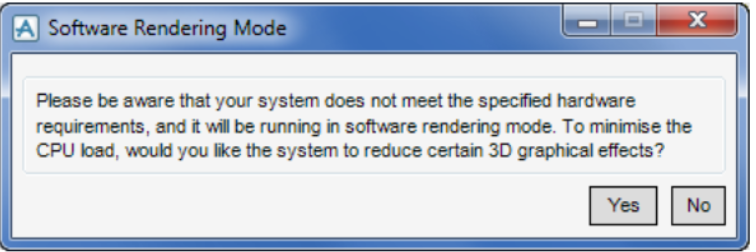
AVEVA Unified Engineering requires appropriate graphics hardware. Without it, the software will run with limited graphical effects, including limited laser data usage, and a warning will be displayed.
Where laser data is utilised, the Graphics Card Memory allocation is an important consideration as this is further exploited inthe visualization and manipulation of laser data (incl. HyperBubble™). Note that the system will post an error message onentering the HyperBubble where the GPU memory is less than 1GB
The AVEVA Unified Engineering release does not currently support AMD Radeon graphics cards.
For optimal graphical memory performance—particularly when working with laser data in Unified Engineering (E3D Design)—it is recommended to adjust the Physical Processor settings when using an NVIDIA graphics card.
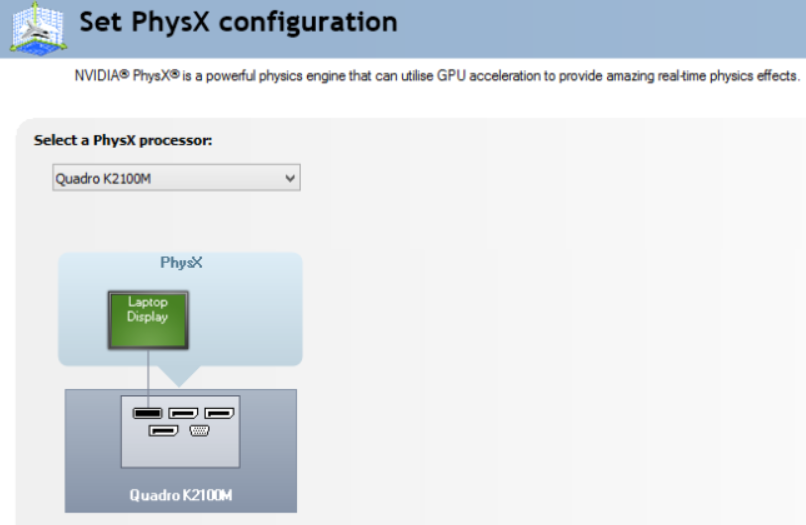
Configuring a GPU through the NVIDIA Control Panel enhances PhysX processing and can improve overall system performance.
Server Configuration
The recommended setup for using AVEVA Unified Engineering in a server environment requires a 64‑bit operating system for the installation of AVEVA Unified Engineering 3.1
| Configuration | Recommendation |
| Operating System(s)*1 | • Windows® Server 2022 (version 21H2 OS build 20348.2849 or higher) |
| Processor Type / Speed | Intel x64 compatible – Modern architecture multiple core processors recommended.(AVEVA E3D Design has been verified using a Server Machine with 4 core CPUs). |
| Memory | 32 GB of high-speed RAMAdditional RAM increases the caching capability and thereby the performance. |
| Hard Disk Storage | The amount of disk space should be configured according to the customer’s requirement based on the number and size of projects (incl. supporting laser data).To secure data and improve performance, the use of RAID 0+1 or 5 storage is recommended; 15k rpm drives are preferred. |
| File System | NTFSFor further information on NTFS, please refer to: https://docs.microsoft.com/enus/windows-server/storage/file-server/ntfs-overview. |
| Network | Gigabit Ethernet (GbE) LAN. 64-bit capable network adapter. The network should provide at least 1 Gb/sec for each workstation. Two or more network cards are recommended for increased performance and redundancy. |